


Eskom Holdings launches agile utility-scale renewable energy business – Eskom Green – and a go-to-market customer strategy to support 24/7 supply and decarbonise grid
Tuesday, 09 June 2026: Eskom Holdings has today launched Eskom Green, a dedicated renewable energy business designed to accelerate the development of utility-scale renewable energy projects and support larger power user customers in achieving their decarbonisation and energy transition objectives.
Eskom Green has been designed in response to global benchmarking research on over 20 utilities. The insights indicate that the development of renewable energy projects requires agile decision-making, access to diverse sources of capital, partnership-based delivery models, and bankable project structures. These differ materially from Eskom’s legacy vertically integrated generation model.
“Eskom Green is a utility-scale renewable energy business that rapidly accelerates the options available to South Africa’s industries to decarbonise and transition industrial and productive capacity to maintain export competitiveness. The business is set toincrease the supply of renewable energy to enable customers to lower their carbon footprint in their energy consumption,” said Group Executive for Eskom Renewables, Rivoningo Mnisi.
“Today’s announcement is not simply about carbon content compliance but delivering leading-edge solutions at scale to enable our customers in implementing their decarbonisation strategies. This new entity is built on decades of power generation skills and expertise the nation has invested in, and Eskom Green reflects successful adaptation to new technologies within Eskom. We have been playing in this space for some time, and we are now putting a stake in the ground – this is a development that South Africa can be proud of,” said Eskom Group Chief Executive, Dan Marokane.
Eskom Green is today part of Eskom Holdings, and as part of the organisation’s unbundling strategy. It will be separated from Eskom to become a wholly owned subsidiary with an independent board, subject to the necessary governance, regulatory and shareholder approvals.
Customer offerings and pricing structure
Eskom Green seeks to be the customer’s primary energy provider. The customer contracts with Eskom Green for its core renewable energy requirements, and Eskom Green takes responsibility for delivering against that requirement using its own renewable generation, supplemented by storage and firming arrangements that support round-the-clock supply where the customer needs it.
The pricing determination will be clear and transparent where the wholesale tariff is passed through to the customer, at cost. The network, wheeling and other regulated wholesale charges levied by the transmission and distribution operators will not be absorbed by Eskom Green and are not marked up. The charges will be presented as a distinct line item separate from the price of energy that Eskom Green generates and sells. This way, the customer has full transparency on what is paid for energy and what is paid for network use.
The foundation phase of the offering will target large industrial demand in mining and manufacturing through Section 34 IRP allocations and direct bilateral Power Purchase Agreements (PPAs) to provide solutions to decarbonise.
Under a take-or-pay structure, the customer commits to a fixed volume and pays the agreed price whether or not the energy is consumed, giving Eskom Green the firm revenue base that anchors Special Purpose Vehicles (SPVs) that will be entered into to finance the projects. As the Eskom Green Portfolio scales, aggregation, ancillary services and wholesale market participation will be added to the service offering. In terms of technology, the pipeline is weighted to solar PV with supporting Battery Energy Storage System (BESS), pumped storage and wind, to provide the asset base from which the 2GW operational target can be delivered.
The second phase of the offering will serve the Eskom Distribution market, leading customer network through the eDX Edge offering, as well as the South African Wholesale Electricity Market (SAWEM) as it develops, the Southern African Power Pool (SAPP) and municipalities.
Decarbonisation strategy support
Since the Integrated Resource Plan (IRP) of 2019, only about 50% of the awarded renewable projects with grid allocation and power offtake agreements have been built. This highlights the need for stronger coordination to maintain energy security while meeting emissions‑reduction targets, and an addressable market that requires decarbonisation solutions at scale and pace.
Eskom Green’s entry into the market is positioned as collaborative and complementary, working alongside private sector participants to help close the generation capacity gap identified in the IRP 2025. By strengthening coordination across the sector, South Africa’s energy supply can be collectively secured, advance emissions reduction targets, and deliver the large-scale, rapid decarbonisation solutions urgently required by industrial customers. The IRP 2025 estimates that for every 10GW of renewables, 6GW of dispatchable power is required (60%).
In line with the IRP 2025, Eskom Green’s contribution is essential to delivering on the overall renewable build targets of 5.6GW by 2030, 21GW by 2035, and 32GW by 2040. The IRP 2025 is pivotal in the decision for Eskom to enter the utility scale renewable energy market segment.
Eskom Green will have about 6GW of carbon-free electricity available up to 2030, as a result of Eskom’s broad pipeline of renewables and storage initiatives currently under development. The entity, as a ring-fenced, wholly owned subsidiary, provides a fit-for-purpose institutional mechanism to enable:
- Dedicated focus on renewable energy development and delivery;
- Improved bankability through ring-fenced financial and governance structures;
- Access to private and concessional capital through project-level SPVs;
- Greater flexibility to partner with experienced private sector participants; and
- Faster and more commercially responsive decision-making within defined governance frameworks.
This approach is consistent with international best practice, where state-owned utilities have established dedicated renewable platforms to scale up delivery while managing balance-sheet, governance, and market-participation risks.
Eskom is engaging with the relevant authorities regarding the governance, funding and regulatory approvals required to support the long-term implementation of Eskom Green.
Availability of Utility Scale renewable energy – ~6GW by 2030 and ~32GW by 2040
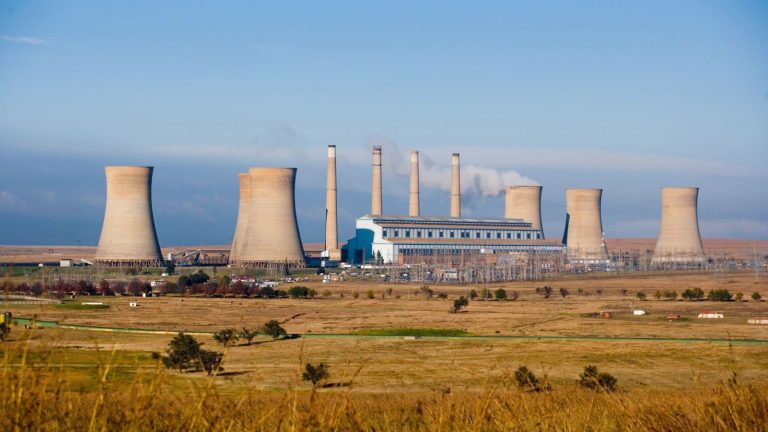
A total of 17 high-priority projects have been identified for implementation across Eskom’s existing coal-fired power station footprint, leveraging established infrastructure to deliver approximately 6GW of additional capacity by 2030. This includes at least 2GW of renewable energy and pumped storage projects expected to advance from 2026, anchored by developments such as the 75MW Lethabo solar PV project in the Free State, marking an important step in integrating new generation capacity with existing assets.
This approach of co-locating renewable and conventional generation will be extended to additional sites, with the next project planned for the Komati Power Station. These projects leverage existing infrastructure to support faster deployment, improve cost efficiencies, and strengthen grid resilience.
Funding for the initial phases has been provisioned within Eskom’s approved capital expenditure programme and is expected to be supported through on-balance sheet funding, in compliance with National Treasury debt relief conditions and without reliance on additional project finance borrowing. These developments are being coordinated through Eskom Green to strengthen delivery focus on new generation capacity, while maintaining alignment with applicable regulatory frameworks and system requirements.
The project pipeline will be implemented in a phased manner to support system reliability while enabling a managed transition and local economic participation. Subsequent stages are expected to incorporate public-private partnerships (PPPs), co-development structures, and hybrid solutions that integrate technologies such as solar PV and BESS, in line with the IRP and long-term security of supply objectives.
In addition to the confirmed availability of ~6GW of renewable energy, Eskom Green will advance a further pipeline of up to 32GW of cost-competitive renewable energy and storage projects by 2040. The 32GW will be funded through dedicated project SPVs. The utilisation of project finance principles for these renewable energy projects to facilitate utility-scale renewable projects through public-private partnerships ensures limited recourse to the Eskom balance sheet while leveraging Eskom’s existing footprint and system knowledge.
ENDS